Cookware: Less prep. More possibility.
Match materials to your cooking habits and check compatibility with your hob.
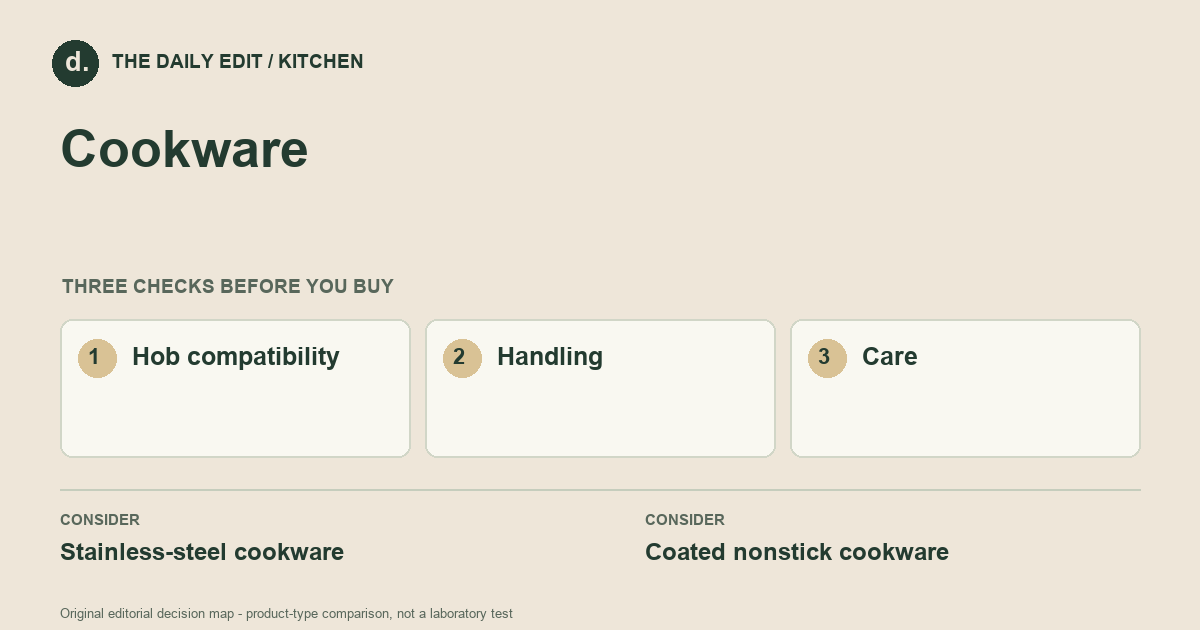
What to look for before you buy
Consider weight, handle comfort, cleaning requirements, and oven limits.
1. Hob compatibility
Check the exact base specification for your hob, especially induction, before choosing a material.
2. Handling
Try the weight with the lid fitted and consider how it feels when full of food.
3. Care
Read the temperature limits and cleaning instructions for the pan, lid, handles, and coating separately.
Compare the main options
Browning vegetables versus delicate eggs
A cook who often browns food may accept the temperature management of stainless steel. Someone mainly preparing delicate foods may prefer the release of a compatible nonstick surface. Neither choice removes the need to follow coating, utensil, and temperature guidance for the exact pan.
| Approach | Advantages | Trade-offs | Best suited to |
|---|---|---|---|
| Stainless-steel cookware | Versatile for browning and compatible with many cooking techniques. | Food release takes attention to temperature and technique. | Cooks who want a durable general-purpose pan. |
| Coated nonstick cookware | Useful for delicate foods and easier release. | Coating care and utensil restrictions limit treatment. | Eggs, pancakes, and lower-effort cleanup. |
Comparison of product types, rather than tested model rankings. On small screens, scroll the table horizontally.
Where to spend — and where to simplify
Buy the pan you will use most often before expanding into a set. Consider lid availability, handle construction, and surface care alongside purchase cost. Paying more for a large heavy pan is poor value if lifting and washing it makes you avoid it. Keep specialty pieces tied to meals you actually cook.
Frequently asked questions
Is cast iron the same as enameled cast iron?
No. Bare seasoned cast iron needs a different care routine; an enamel surface does not require seasoning. Follow the instructions for the specific finish.
Can every pan go in the oven?
No. Oven suitability can be limited by handles, lids, coatings, or temperature ratings; check all parts rather than assuming from the main material.
When does a cookware set make sense?
When its individual sizes match your routine and the included pieces cost less than the pieces you would genuinely buy separately.
Cover photograph: Cooks & Kitchens from Darlington, UK · CC BY 2.0. Photo details. Illustrative photograph; not a tested product recommendation.
Sources and what they support
References checked 17 October 2026. Model-specific instructions remain specific to that model; a source link is not a product endorsement.
- Le Creuset: Care and UseManufacturer documentation
Manufacturer instructions differ by cookware material; nonstick heat advice applies to its nonstick range.
- Lodge: Enameled cast iron careSupporting reference
Care guidance for enamel, including the distinction from seasoned cast iron.
AI-assisted editorial analysis; no hands-on product testing has been conducted for these guides. Read our editorial approach. Verify current specifications, care instructions, compatibility, and return terms for the exact item before ordering.


