Choosing a cutting board
Think about the foods you prepare and the space beside your sink.
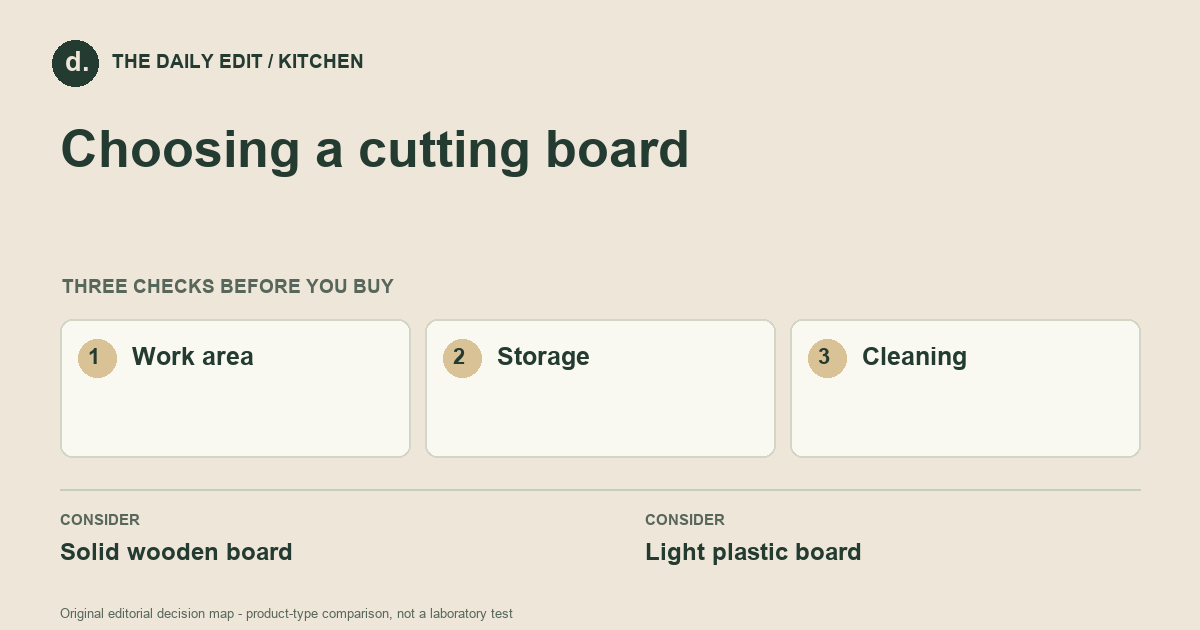
What to look for before you buy
Check dimensions, stability, cleaning instructions, and whether the board fits your drying area.
1. Work area
Choose enough room for the food and your knife movement without covering the entire counter.
2. Storage
Check whether the board fits beside the sink and can dry with air around it.
3. Cleaning
Read the cleaning guidance for the exact material and replace boards that are difficult to keep clean.
Compare the main options
Small produce prep versus a large meal
For one onion and a sandwich, a compact board may be enough. For several ingredients, too little working area causes repeated transfers and a crowded edge. Compare the available counter with the board's full footprint, then check that you can lift it comfortably for washing.
| Approach | Advantages | Trade-offs | Best suited to |
|---|---|---|---|
| Solid wooden board | Provides a substantial cutting surface and a familiar feel. | Usually needs hand washing, drying, and material-specific care. | Home cooks who can maintain a heavier board. |
| Light plastic board | Easy to carry and available in several sizes. | Can move unless stabilized and becomes worn with use. | Small kitchens and separate prep tasks. |
Comparison of product types, rather than tested model rankings. On small screens, scroll the table horizontally.
Where to spend — and where to simplify
A useful first board should fit your knife, sink, drying area, and usual batch size. Spend on stable handling and a care routine you will follow before buying several decorative boards. Include a suitable storage arrangement; a board that stays damp or never fits the sink can create more work than its price suggests.
Frequently asked questions
Can I put a wooden board in the dishwasher?
Only if the maker explicitly allows it; many wooden boards require hand washing and prompt drying.
Is a groove always useful?
It can contain some juices but reduces flat working area and adds a channel to clean.
When is a second board more useful than a larger first board?
When you need to separate distinct preparation tasks or use a compact board for quick jobs without washing the largest one each time.
Cover photograph: Pexels contributor · Pexels License. Photo details. Illustrative photograph; not a tested product recommendation.
Sources and what they support
References checked 17 October 2026. Model-specific instructions remain specific to that model; a source link is not a product endorsement.
- USDA FSIS: Cutting BoardsGovernment guidance
Government food-safety guidance, not a knife-edge performance comparison.
AI-assisted editorial analysis; no hands-on product testing has been conducted for these guides. Read our editorial approach. Verify current specifications, care instructions, compatibility, and return terms for the exact item before ordering.


