Toy storage: A place for every little thing.
Start with the toys you need to store and where your child plays most often.
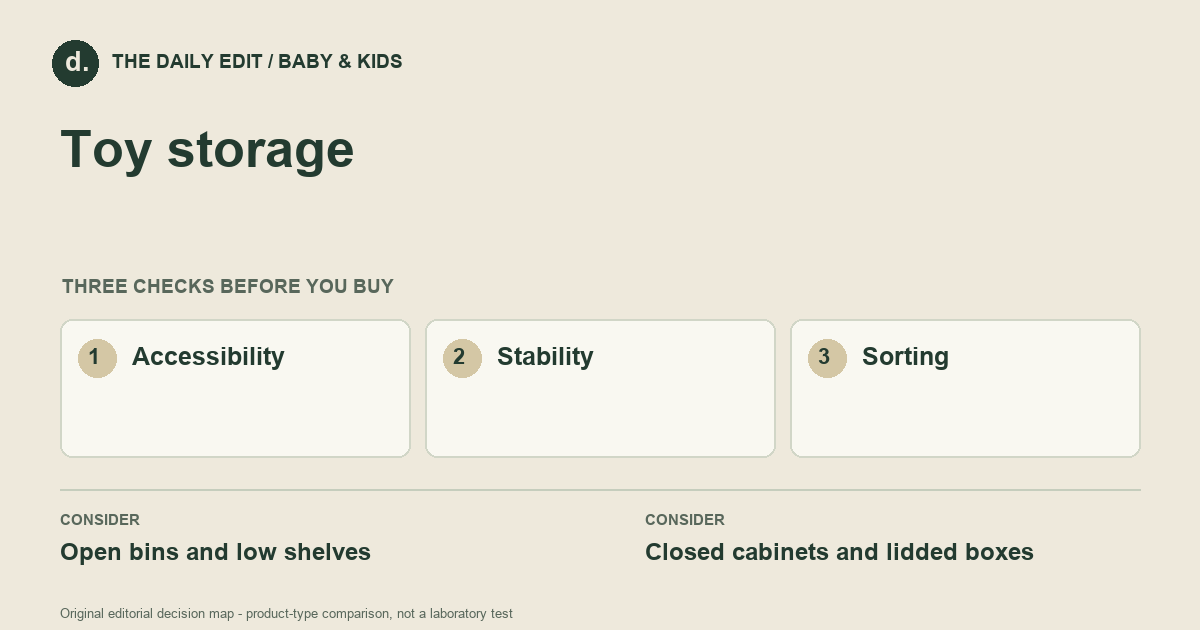
What to look for before you buy
Check age suitability, stability, access, and manufacturer assembly or anchoring instructions.
1. Accessibility
Put commonly used age-appropriate toys where they can be reached without climbing.
2. Stability
Follow the furniture's anchoring instructions and use suitable fixings for the wall.
3. Sorting
Group by how the child plays, not simply by matching container colors.
Compare the main options
Shared living room versus play corner
A shared room may benefit from a few closed boxes for occasional sets and open access for current favorites. A dedicated play corner can use more visible storage. Sort by the way toys are actually used, and keep age-inappropriate small parts in suitable separate storage.
| Approach | Advantages | Trade-offs | Best suited to |
|---|---|---|---|
| Open bins and low shelves | Make toys visible and easy to return. | Small objects and visual clutter remain exposed. | Supervised play areas with frequently used toys. |
| Closed cabinets and lidded boxes | Contain loose pieces and create a quieter-looking room. | Doors and lids add steps and require suitable child access. | Rotating collections or shared living spaces. |
Comparison of product types, rather than tested model rankings. On small screens, scroll the table horizontally.
Where to spend — and where to simplify
Start with the toy groups used most often and buy only the containers that fit them. Pay for appropriate stability, accessible openings, and cleaning rather than a large matching wall of boxes. Include required anchoring equipment and installation when comparing furniture prices; decorative bins do not replace structural requirements.
Frequently asked questions
Do low shelves still need anchoring?
Follow the manufacturer's instructions. Height alone does not establish stability; CPSC recommends anchoring furniture to reduce tip-over risk.
Are clear boxes better?
They make contents visible, while opaque boxes reduce visual clutter. Either works when the opening, weight, and contents suit the child's age.
How do I avoid buying too much storage?
Sort and measure the collection first, then trial a small number of containers before committing to a larger system.
Cover photograph: Pexels contributor · Pexels License. Photo details. Illustrative photograph; not a tested product recommendation.
Sources and what they support
References checked 17 October 2026. Model-specific instructions remain specific to that model; a source link is not a product endorsement.
- CPSC: Storage and Toy Chest DangersGovernment guidance
Government safety guidance on latches, ventilation and lid supports.
- CPSC: Anchor It!Supporting reference
Consumer guidance on anchoring furniture and reducing tip-over risks.
AI-assisted editorial analysis; no hands-on product testing has been conducted for these guides. Read our editorial approach. Verify current specifications, care instructions, compatibility, and return terms for the exact item before ordering.


