Make the most of entryway storage
Keep a list of the shoes, keys, and bags that arrive at the door.
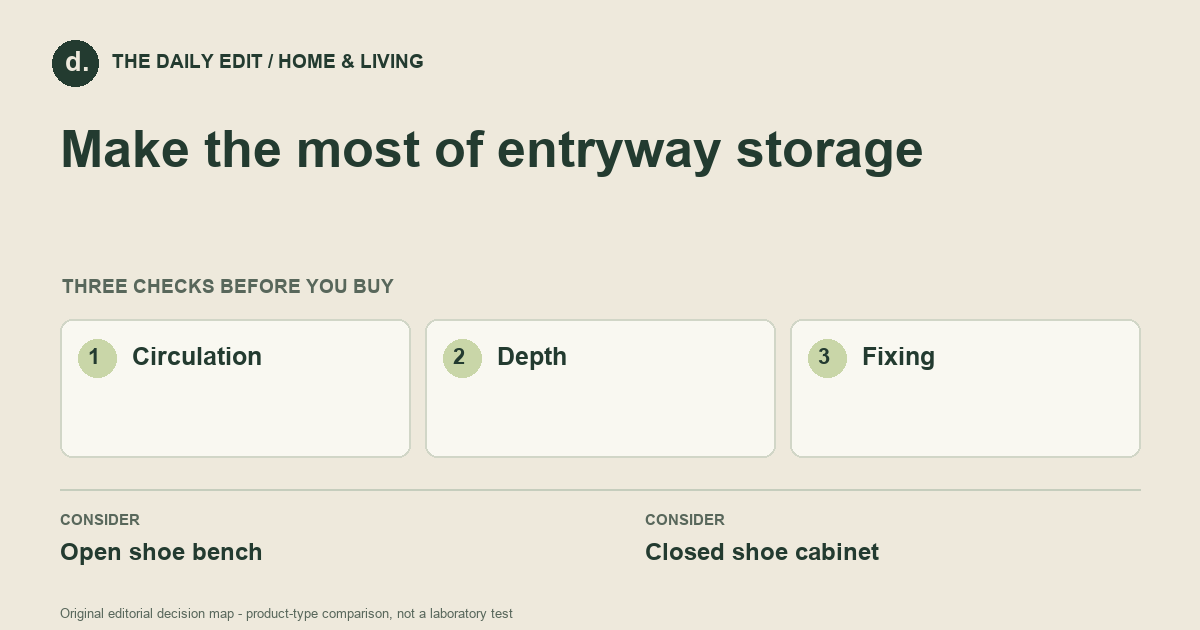
What to look for before you buy
Check walking clearance, shelf depth, weight limits, and any anchoring requirements.
1. Circulation
Leave enough clear width to enter, turn, and open the door with a bag in hand.
2. Depth
Compare internal shelf space with the longest shoes and boots you use.
3. Fixing
Check the construction, load limits, and anchoring requirements before installation.
Compare the main options
Narrow entrance versus family drop zone
A narrow entrance needs a clear walking route and a fully opening door before it needs more capacity. A wider family area may benefit from a seat and assigned daily spaces. Measure boots and bags as well as shoes so the planned storage reflects real arrivals.
| Approach | Advantages | Trade-offs | Best suited to |
|---|---|---|---|
| Open shoe bench | Provides a seat and quick access to shoes. | Leaves contents visible and can gather dust. | Busy entrances with daily footwear. |
| Closed shoe cabinet | Keeps the entrance visually tidy. | Needs door clearance and limits larger footwear. | Shared living areas where concealed storage matters. |
Comparison of product types, rather than tested model rankings. On small screens, scroll the table horizontally.
Where to spend — and where to simplify
Include any anchoring, assembly, and wall-clearance needs in the total. A compact unit that holds the daily shoe rotation can be better value than a larger cabinet filled with occasional pairs. Pay for usable internal depth and door movement before decorative storage features or a matching entrance collection.
Frequently asked questions
Should I store every pair by the door?
Usually a smaller daily rotation is easier to manage. Keep occasional footwear elsewhere if space is tight.
Can a storage cabinet double as a seat?
Only if it is designed and rated for sitting. A flat top does not establish a suitable load rating.
What should decide between a bench and a cabinet?
Whether you need an approved sitting surface, concealed storage, or both, together with the space required for safe access and door movement.
Cover photograph: Pexels contributor · Pexels License. Photo details. Illustrative photograph; not a tested product recommendation.
Sources and what they support
References checked 17 October 2026. Model-specific instructions remain specific to that model; a source link is not a product endorsement.
- IKEA: GULLABERG Shoe CabinetManufacturer documentation
Manufacturer dimensions and fitting requirements for this cabinet only; check assembly instructions.
- CPSC: Anchor It!Supporting reference
Consumer guidance on anchoring furniture and reducing tip-over risks.
AI-assisted editorial analysis; no hands-on product testing has been conducted for these guides. Read our editorial approach. Verify current specifications, care instructions, compatibility, and return terms for the exact item before ordering.


