Headphones: Find a little focus.
Decide where you listen most. A busy commute and a quiet home office have different needs.
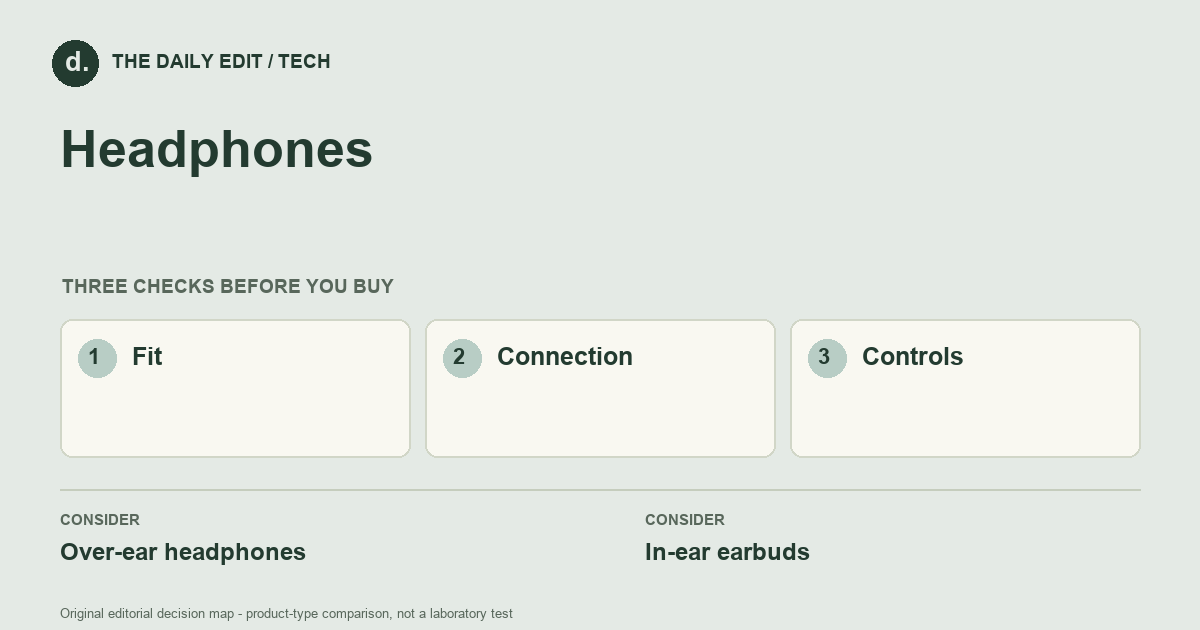
What to look for before you buy
Compare comfort, microphone quality, battery life, and compatibility with your devices.
1. Fit
Wear the headphones long enough to notice pressure around glasses, the headband, or ear tips before judging comfort.
2. Connection
Check wired, wireless, microphone, and device-switching support for your actual phone and computer.
3. Controls
Make sure volume, mute, and playback are usable without repeatedly opening an app.
Compare the main options
Office calls versus a commute
A desk worker should test microphone pickup, device switching, and comfort with glasses. A commuter may instead value pocket size and a secure fit. Try the same pair for both tasks before assuming strong music performance guarantees clear calls in your room.
| Approach | Advantages | Trade-offs | Best suited to |
|---|---|---|---|
| Over-ear headphones | Larger cushions can suit extended listening and provide a stable fit. | Bulkier to pack and can feel warm. | Desk work and longer listening sessions. |
| In-ear earbuds | Compact and convenient for commuting. | Comfort and isolation depend heavily on ear-tip fit. | Listeners prioritizing pocketable size. |
Comparison of product types, rather than tested model rankings. On small screens, scroll the table horizontally.
Where to spend — and where to simplify
Pay for the fit and connection you need before extra listening modes. Check whether replacement ear pads or tips are available: a replaceable contact part can matter more over time than another app feature. Include a case or needed cable in the total, especially for a daily travel pair.
Frequently asked questions
Will noise cancellation block every sound?
No. It is typically more effective against steady background noise than unpredictable voices; fit and passive isolation also matter.
Do I need a separate microphone?
Try the headset in your normal room first. Call quality depends on microphone placement and surrounding noise as well as the headphones.
What can make an expensive pair poor value?
Uncomfortable pressure, incompatible call controls, or unavailable replacement pads can outweigh extra sound modes you rarely use.
Cover photograph: Florian Fuchs · CC BY-SA 3.0. Photo details. Illustrative photograph; not a tested product recommendation.
Sources and what they support
References checked 17 October 2026. Model-specific instructions remain specific to that model; a source link is not a product endorsement.
- NIDCD: How Loud Is Too Loud?Government guidance
Government hearing guidance; does not rank headphone models.
AI-assisted editorial analysis; no hands-on product testing has been conducted for these guides. Read our editorial approach. Verify current specifications, care instructions, compatibility, and return terms for the exact item before ordering.


