Choosing an accessory pouch
Group the small objects that get lost in your everyday bag.
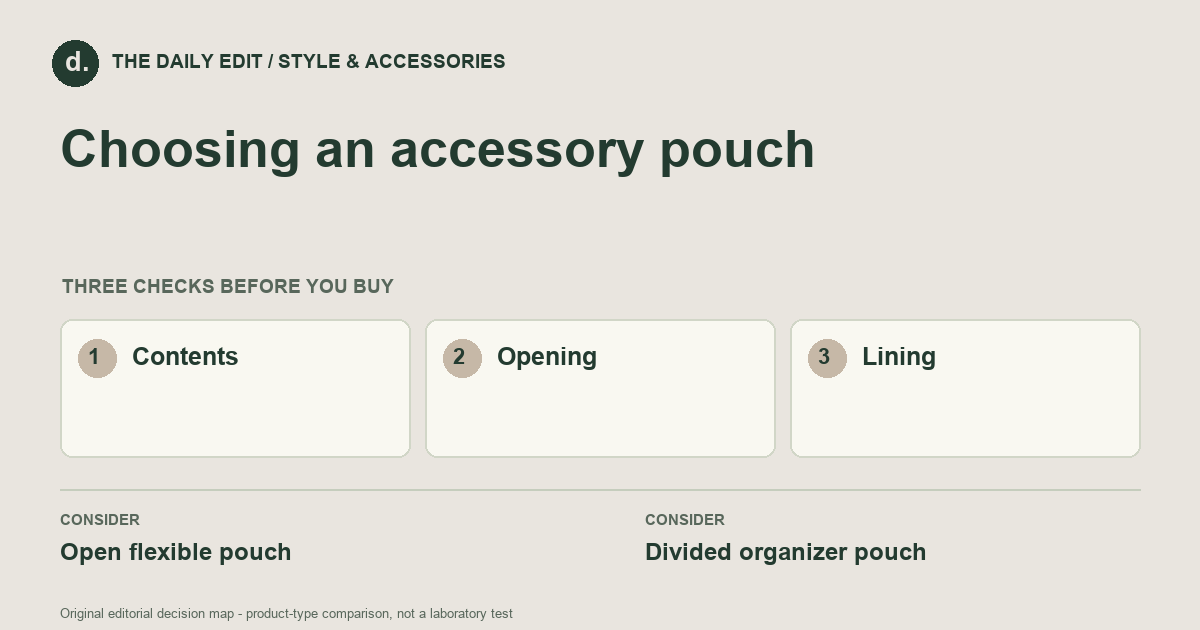
What to look for before you buy
Compare opening width, internal pockets, lining, and overall dimensions.
1. Contents
Lay out the items and check the largest connector, adapter, or tool against internal space.
2. Opening
Choose access that lets you see the bottom without emptying everything.
3. Lining
Compare visibility, cleaning, and how easily small objects catch in seams.
Compare the main options
Changing travel kit versus a fixed desk-to-office set
A changing kit may need open space for different adapters or tools. A fixed daily set may benefit from visible assigned positions. Lay out the largest connector and the thickest cable before judging an organizer from its empty pocket count.
| Approach | Advantages | Trade-offs | Best suited to |
|---|---|---|---|
| Open flexible pouch | Fits varied small objects and packs into spare space. | Contents can shift and become harder to find. | A changing everyday kit. |
| Divided organizer pouch | Keeps cables, pens, and other items in defined spots. | Fixed sections can limit bulky or unusual shapes. | A consistent collection of small accessories. |
Comparison of product types, rather than tested model rankings. On small screens, scroll the table horizontally.
Where to spend — and where to simplify
Price the organizer around the small kit that repeatedly travels with you, not every accessory you own. Dividers add value only when they fit and remain useful as equipment changes. A flexible pouch can be more economical for varied contents; a tightly arranged case may be worth it for a stable daily set.
Frequently asked questions
Does a bright lining help?
It can make dark items easier to see, especially in low light; compare that benefit with material and cleaning preferences.
Should cables have elastic loops?
They can help organization, but avoid bends or tension that the cable maker does not recommend.
What should I avoid with cable loops or elastic retainers?
Forced bends, tension, or pressure inconsistent with the cable maker's guidance; orderly storage should not strain the items it holds.
Cover photograph: Readymade · Pexels License. Photo details. Illustrative photograph; not a tested product recommendation.
Sources and what they support
References checked 17 October 2026. Model-specific instructions remain specific to that model; a source link is not a product endorsement.
- Samsonite: The Art of PackingManufacturer documentation
Manufacturer packing advice for separating liquids, electronics and dirty shoes; not evidence that every pouch is leakproof.
AI-assisted editorial analysis; no hands-on product testing has been conducted for these guides. Read our editorial approach. Verify current specifications, care instructions, compatibility, and return terms for the exact item before ordering.


